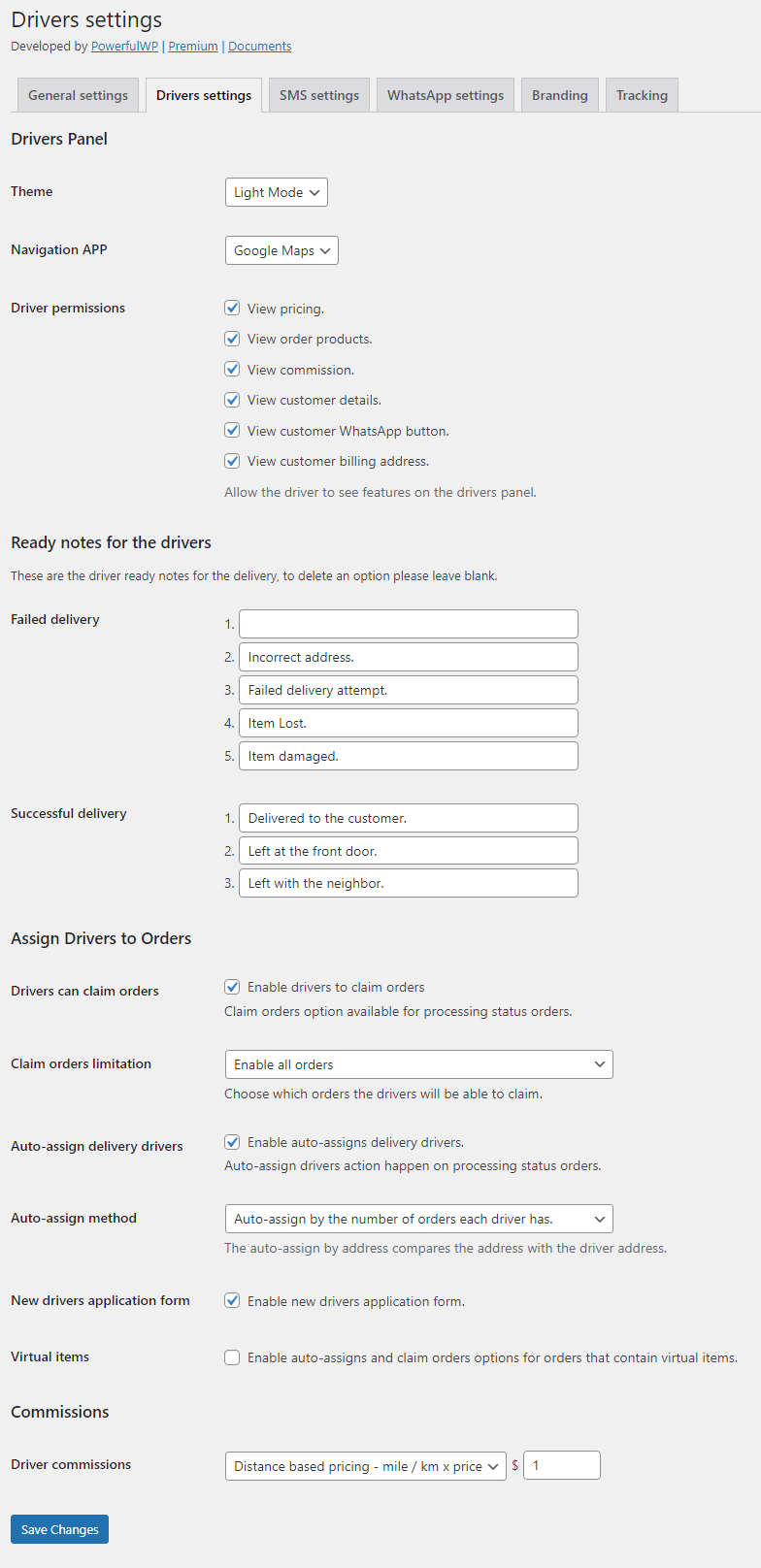
The Driver Settings section of the Local Delivery Drivers for WooCommerce Premium lets you configure how delivery drivers interact with your store, control what information they see, and determine how orders are assigned and commissions calculated. These settings apply globally to all drivers.

Driver Panel Theme
Set the default appearance for the driver panel.
- Choose between Light Mode and Dark Mode
- Drivers can override the default from their personal panel settings
This allows you to provide a consistent visual experience while still giving drivers control over their preferences.
Default Navigation App
Select the default navigation app used when a driver opens a delivery route.
- Supported options include Google Maps, Waze, and Apple Maps
- Drivers can change their preferred app within their driver panel
This ensures seamless navigation based on each driver’s device and preferences.
Driver permissions
Control which details are visible to drivers in their panel. You can enable or disable:
- View pricing – Show delivery fees and product prices
- View order products – Display the full list of ordered items
- View commission – Show the calculated commission for each delivery
- View customer details – Display the customer’s name, phone number, and address
- View customer WhatsApp button – Allow direct contact with customers via WhatsApp
- View customer billing address – Show the billing address associated with the order
These permissions help you manage privacy and streamline the information flow based on your delivery workflow.
Proof of Delivery
Require drivers to collect proof before completing delivery:
- Mandatory photo
- Mandatory signature
- Mandatory photo or signature
You can also set the maximum number of images a driver can upload (e.g., 6).
Ready notes for the drivers
Ready notes are prewritten messages that drivers can use when updating an order’s delivery status.
- Configure separate notes for successful and failed deliveries
- Notes can be customized or removed as needed
- Drivers can also write custom notes when required
Ready notes help standardize communication while saving time during busy delivery periods.
Claim Orders
Enable this option to allow drivers to claim available orders from the driver panel.
When enabled:
- Drivers with claim permission can view and claim orders that are in the selected Order Processing Status
- Only unassigned orders will appear in the claim screen
Claim Order Conditions
Use claim rules to limit which orders drivers can claim based on location. Available options:
- All orders – No restrictions
- Shipping city matches driver city
- Pickup city matches driver city
- Either shipping or pickup city matches driver city
Auto-Assign Delivery Drivers
Automatically assign available drivers to new orders when they reach the defined Order Processing Status.
Assignment Methods
- By number of orders – Assign evenly based on how many orders each driver currently has.
- By shipping location + order count – Assign using a hierarchy of shipping zip code, city, state, country, and current order count.
- By shipping city – Assign if the shipping city matches the driver’s city.
- By pickup location + order count – Assign using pickup zip code, city, state, country, and current order count.
- By pickup city – Assign if the pickup city matches the driver’s city.
- By shipping or pickup city – Assign if either city matches the driver’s city.
⚠️ Auto-assign is disabled for:
- Orders with local pickup
- Orders containing virtual products
- Orders using a shipping method excluded from auto-assignment
When multiple drivers meet the criteria, the plugin assigns the one who was least recently assigned.
Auto-assignment helps streamline operations for high-volume stores.
You can enable auto-assign drivers to suborders if they exist.
Driver Delivery Areas (Multiple Cities)
Each driver can have one or more delivery cities assigned in their profile. These cities are used to match orders for claim and auto-assign logic.
This feature helps stores support regional driver assignments across multiple zones.
Driver Application Form
Enable a public-facing application form for new drivers.
- A “New Driver” link appears on the login screen of the driver panel
- Applicants submit their details through a form
- Admins receive the application by email and can create new driver accounts manually
This makes it easy to accept applications and expand your delivery team without giving access to the WordPress admin.
Virtual items
Enable this setting to include orders containing virtual products in driver claims and auto-assignment.
This option is helpful if your virtual products require physical delivery or coordination (e.g., printed certificates or bundled items).
Driver Commissions
Configure how drivers are paid for completed deliveries. The plugin supports multiple commission models to fit your business needs.
You can select from the following commission types:
1. Fixed Price
Pay a flat rate per completed delivery.
Example: $20 per delivery
2. Delivery Total Percentage
Pay a percentage based on the shipping fee.
Example: $40 shipping × 50% = $20 commission
3. Order Total Percentage
Pay a percentage of the total order value.
Example: $100 order × 50% = $50 commission
4. Distance
Pay based on delivery distance (in miles or kilometers).
Example: 20 km × $1 = $20 commission
5. Time
Pay based on the duration of the delivery in minutes.
Example: 30 minutes × $1 = $30 commission
6. Distance + Time
Combine both distance and time to calculate a single commission.
Example: (10 km × $1) + (15 min × $1) = $25 commission
7. Fixed Price + Distance
Apply a base rate plus a distance-based fee.
Example: $10 + (15 km × $1) = $25 commission
How It Works
- Commissions are calculated automatically when an order is marked as Delivered
- Admins can view full commission reports by date and driver from the WordPress dashboard
- Drivers can view their personal earnings in the driver panel
- Distance and time-based commissions require valid Google Maps API keys for accurate calculations
Choose the commission structure that best aligns with your delivery operation and driver compensation strategy.