1. Home
  2. Docs
  3. Local Delivery Drivers fo...
  4. Getting Started
  5. WhatsApp Settings

WhatsApp Settings

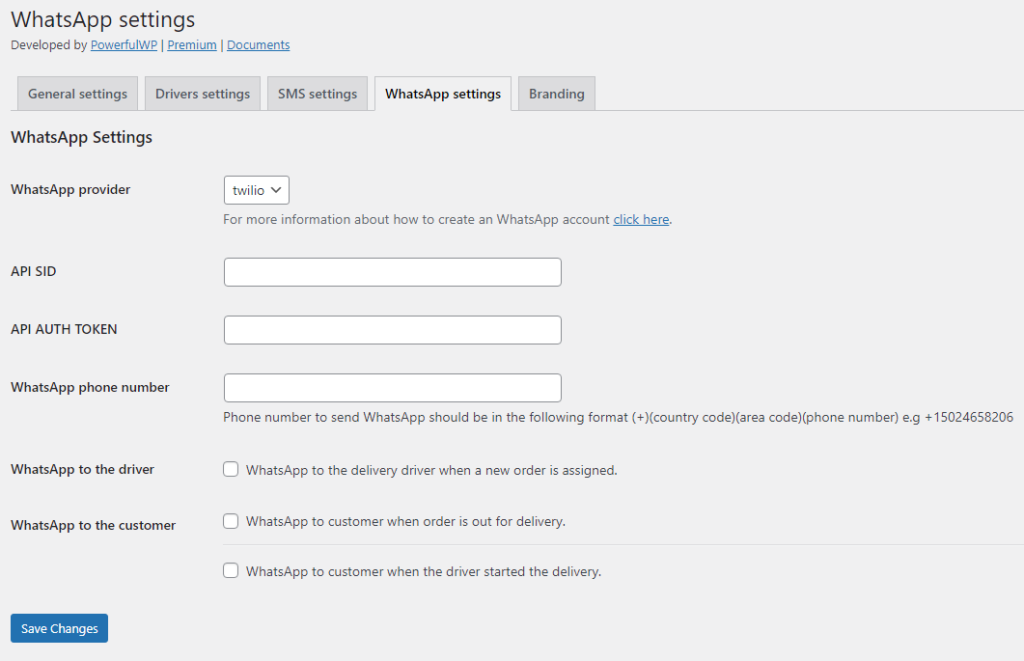
Use the WhatsApp Settings section of the Local Delivery Drivers for WooCommerce Premium plugin to configure automated WhatsApp notifications for both delivery drivers and customers. The plugin integrates with Twilio’s WhatsApp Business API, allowing you to send approved message templates at key points during the delivery workflow.

WhatsApp settings

WhatsApp Provider

Select your provider for WhatsApp messaging.
Currently, the plugin supports:

  • Twilio

For setup guidance, visit How to create a WhatsApp account on Twilio

API Credentials

To enable WhatsApp messaging, you must enter the following Twilio credentials:

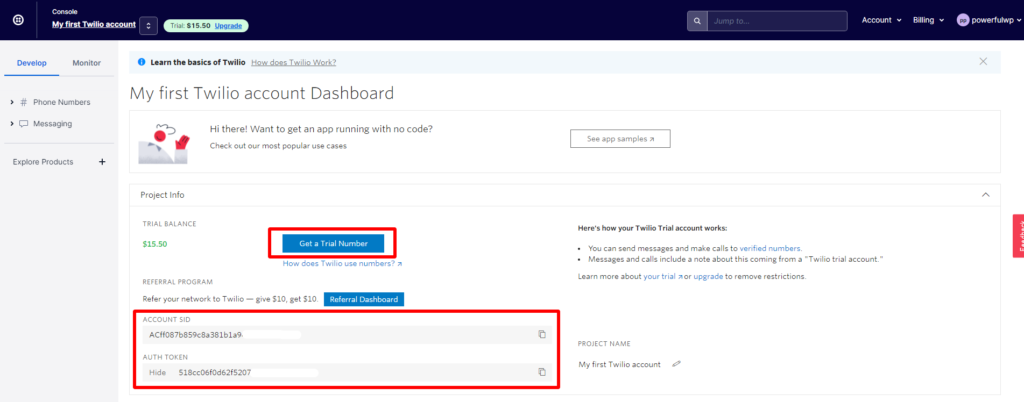
  • API SID – Your Twilio Account SID
  • API Auth Token – Your Twilio Auth Token
  • WhatsApp Phone Number – The Twilio number used to send messages
    • Must be formatted as + followed by country code and phone number (e.g., +15024658206)
    • The number must be registered and approved for WhatsApp messaging by Twilio

Trial accounts can only use the phone number assigned by Twilio and are limited to sandbox testing.

WhatsApp Notifications

The plugin supports automated WhatsApp messages for both drivers and customers, using Twilio-approved message templates.

Each message uses a Content Template SID and accepts dynamic variables via template placeholders (e.g., {{1}}, {{2}}, etc.).

WhatsApp to the Driver

Enable this option to send a WhatsApp message to the delivery driver when a new order is assigned.

Settings:

  • Content Template SID – Enter the SID of the WhatsApp template approved in your Twilio account
  • Template Variables – Map dynamic data to Twilio placeholders (e.g., {{1}}, {{2}}, etc.)

Each variable can include plain text or predefined shortcode tags. Examples:

  • [order_id]
  • [shipping_method]
  • [delivery_driver_first_name]

You can add up to four variables and choose tags using the Show/Hide Tags interface.

WhatsApp to the Customer

Enable notifications to the customer for the following delivery events:

  • Out for Delivery – When the driver sets the order as out for delivery
  • Start Delivery – When the driver clicks “Start Delivery” to begin tracking
  • Delivery Confirmed – When the driver marks the order as delivered
  • Failed Delivery Attempt – When the driver marks the delivery as unsuccessful

Settings:

  • Content Template SID – Enter the Twilio-approved SID for your customer message
  • Template Variables – Add and map variables using shortcodes or custom text

You can insert dynamic placeholders such as:

  • [order_id]
  • [order_currency]
  • [billing_first_name]
  • [tracking_url]

Each variable corresponds to one of Twilio’s template placeholders ({{1}}, {{2}}, etc.). You can add up to four.

Testing with Twilio Sandbox

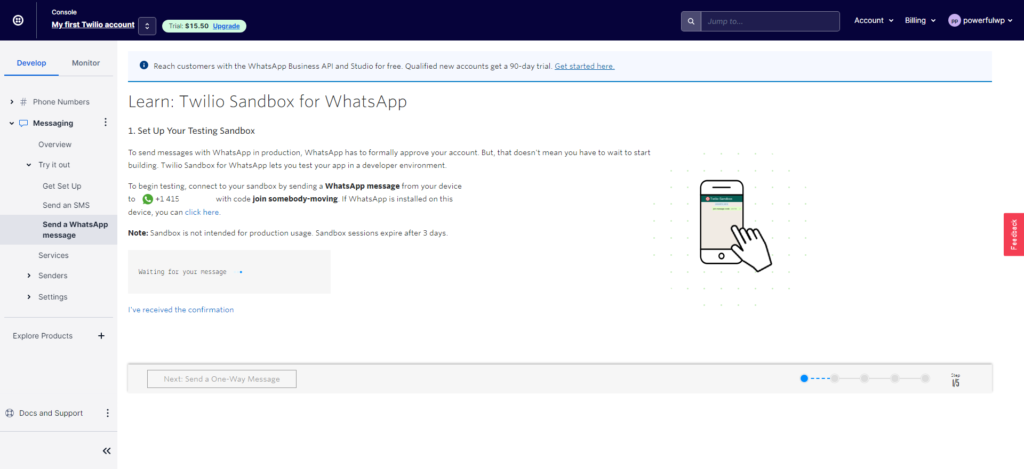
Before moving to production, you can test WhatsApp messages using Twilio’s sandbox environment.

To enable sandbox testing:

  1. Log in to your Twilio Console
  2. Go to Messaging > Try it Out > WhatsApp Sandbox
  3. Follow the instructions to link your personal WhatsApp number
  4. Use the sandbox phone number in your plugin settings for test messages

Only Twilio’s three default templates are available during sandbox testing.

Sandbox Limitations

  • Custom templates cannot be used until approved
  • You can only send messages to verified test numbers
  • Sandbox messages are limited to Twilio’s default template structure

Tags for WhatsApp Template Variables

You can use the following tags inside WhatsApp template variables to personalize messages sent to customers and drivers:

TagDescription
[delivery_driver_first_name]Delivery Driver First Name
[delivery_driver_last_name]Delivery Driver Last Name
[driver_page_url]Driver Panel Login URL
[store_name]Your WooCommerce Store Name
[order_id]WooCommerce Order ID
[order_date]Order Creation Date
[order_status]Current Order Status
[order_total]Total Amount of the Order
[order_currency]Order Currency Code
[shipping_method]Selected Shipping Method
[payment_method]Selected Payment Method
[billing_first_name]Customer’s Billing First Name
[billing_last_name]Customer’s Billing Last Name
[billing_company]Billing Company Name
[billing_address_1]Billing Address Line 1
[billing_address_2]Billing Address Line 2
[billing_city]Billing City
[billing_state]Billing State or Province
[billing_postcode]Billing Postal Code
[billing_country]Billing Country
[billing_phone]Billing Phone Number
[shipping_first_name]Shipping First Name
[shipping_last_name]Shipping Last Name
[shipping_company]Shipping Company Name
[shipping_address_1]Shipping Address Line 1
[shipping_address_2]Shipping Address Line 2
[shipping_city]Shipping City
[shipping_state]Shipping State or Province
[shipping_postcode]Shipping Postal Code
[shipping_country]Shipping Country
[eta]Estimated Time of Arrival
[tracking_url]Link to the Live Tracking Page

These tags are automatically replaced with live order and delivery information when the WhatsApp message is sent. Be sure to match the number of variables ({{1}}, {{2}}, etc.) with the number of placeholders required by your template.